This is already strong, warm, practical, and particularly good at distinguishing tradition, family practice, and diaspora adaptation. I’ve proofread it for grammar, punctuation, sentence flow, consistency, and a few awkward constructions while preserving the conversational voice and humour.
Proofread version
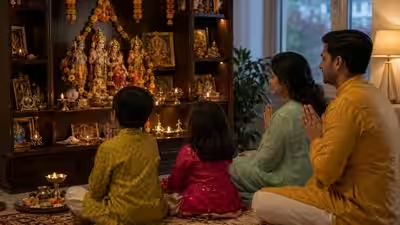
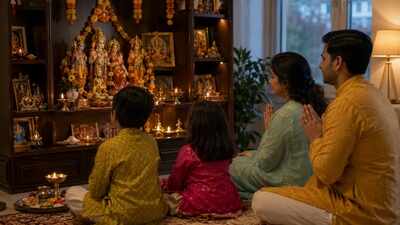
Most Hindu families in the US and UK are not struggling with belief. They’re struggling with Tuesday. The school run. A late train. A child’s football practice. A flat with no spare room. A smoke alarm that reacts faster than your devotion. That’s the real setting in which many families are trying to keep a home mandir, or home shrine, alive.A weekly home-temple rhythm helps because it asks less than a full ritual life while preserving more than random, once-in-a-while prayer. It gives the household one dependable point in the week when the lamp is lit, the names of Bhagavan, the Lord, are spoken, and children see worship as part of family life rather than something that happens only during Diwali or on a rushed temple trip.
The corner matters more than the square footage
You do not need a dedicated puja room to begin. A shelf, a small cabinet top, or the upper section of a bookcase can work if it is kept clean and treated with respect. In many diaspora homes, the honest limit is space. A one-bedroom flat in London or a townhouse in New Jersey does not suddenly become a traditional ancestral home because we wish it to.Choose one stable spot. Don’t keep shifting the altar every week unless you have no choice. Place the murti, sacred image, or framed pictures your family actually worships, not a collection built to look complete.If your sampradaya, or lineage or devotional tradition, centres one deity, let that be visible. A Vaishnava family may keep Vishnu, Krishna, Rama, or Lakshmi Narayana at the centre. A Shaiva family may place Shiva or a linga, an aniconic form of Shiva. A Devi family may centre Durga, Lakshmi, or another form of the Goddess. Family continuity matters here.Keep the altar compact. One small bell, a diya, or oil lamp, an enclosed lamp, incense only if your building allows it, a small water vessel, and one plate for offerings are enough for weekly worship. If clutter builds up, the place starts feeling like storage, not prayer.
What a weekly rhythm actually looks like
If it’s not scheduled, it usually won’t happen. Put the weekly puja slot on the shared family calendar the same way you’d mark swimming lessons or a parent-teacher meeting. For some homes, that will be Friday evening after work. For others, Sunday morning before grocery shopping. The ideal day is the day your family can keep.Keep the format repeatable. Fifteen to twenty-five minutes is realistic for many households.Light the lamp. Offer water and fruit. Recite a short stotra, devotional hymn, or nama japa, repetition of the divine name. Read a few verses from a text your family knows. End with arati, the waving of light, and prasad, blessed food.Children do better with repetition than with length. If they know that every Sunday at 10 a.m. the lamp is lit and one bhajan, devotional song, is sung, that pattern will stay with them.
Canonical ritual, family custom, and adaptation abroad are not the same thing
This distinction needs to be said plainly.Canonical ritual means practices prescribed in texts or maintained in a sampradaya with clear ritual rules, often including specific mantras, materials, timings, and, in some cases, priestly guidance. A full archana, formal offering, homa or havan, fire ritual, or vrata, religious observance, may fall into this category depending on the tradition.Family custom means what your household has received and repeated over time. Maybe your grandmother always offered tulsi, holy basil, to Krishna on Thursdays. Maybe your family sings the Hanuman Chalisa every Tuesday. Maybe a small bowl of kheer, sweet milk pudding, is offered on Purnima, the full moon. These customs matter, even when they are not universal.Pragmatic adaptation abroad is what families do because life in Boston, Birmingham, or Seattle does not always permit the full form. Watching a temple livestream of arati because the nearest temple is ninety minutes away is an adaptation. Using a battery lamp in a student flat with strict housing rules is an adaptation. Offering locally available flowers when the traditional variety is unavailable is an adaptation.These are not all equal in status. Adaptation is not fake, but it should be named honestly. If you are unsure whether a substitution is acceptable in your tradition, confirm with elders, your family priest, or a local temple.
The prayers that travel well
Some parts of practice carry across continents with very little loss. Nama japa travels well. So does simple arati. So do short stotras such as selections from the Vishnu Sahasranama, Lalita Sahasranama, or Hanuman Chalisa, or Mahamrityunjaya mantra japa, depending on family tradition.Audio can help, especially in households where the adults understand the words but the children do not yet know the tune. Use mantra recordings from a temple, a trusted acharya, teacher, or your own family source if possible. A playlist built from random internet clips can become confusing fast.Keep one small folder or playlist for the weekly slot: one opening chant, one family hymn, and one arati.If grandparents are in India, ask them to record the version your family uses. That voice will do more for continuity than a polished studio track.
Flame, smoke alarm, and common sense
Diaspora homes have their own ritual theology, and one of its chief deities is the smoke detector.If you can light a diya safely, do it with attention. Place it on a metal or ceramic plate. Keep it away from curtains, paper decorations, and children’s sleeves. Never leave it unattended. Extinguish it before leaving the room.If your apartment rules are strict, or you have very young children, use an enclosed deepam, or lamp, or a supervised tealight in a holder. If open flame is not possible at all, a battery lamp may be used as a practical stand-in for the weekly family gathering, but it is still a practical stand-in, not the same as the traditional flame. That honesty matters.The same goes for incense. If it triggers alarms or breathing issues, skip it. Fragrance is not the heart of worship.
Temple visits when the temple is far away
A home rhythm should not turn into a quiet replacement for temple life if temple access exists. The temple brings darshan, sacred sight, community, priestly guidance, and festival experiences that a living room cannot reproduce.But many families do not have easy access. In parts of the UK, reaching a temple can mean a long drive and parking drama. In the US, the nearest mandir may be in another county. In winter, even that trip gets harder.So think in layers. Weekly at home. Monthly or fortnightly at the temple if feasible. Festival days by plan, not by accident.Check your local temple calendar early. Many major temples in the US and UK publish annual calendars online. If your family observes vrat dates, choose one governing panchanga, or Hindu almanac, and stick with it rather than comparing five apps and getting five answers. Dates can differ by location. Some 2026 observances, as diaspora calendars note, may fall on different local dates depending on time zone and tithi, or lunar-day, boundaries.
Finding a pandit in the right time zone
This sounds mundane, but it saves a lot of frustration. If you want occasional guidance, find a priest who can work in your time zone and in your preferred language.A family in Manchester may want Hindi or Gujarati. A family in New Jersey may need English with some Sanskrit. Tamil-, Telugu-, Kannada-, Bengali-, and Malayalam-speaking communities often already know which temple priests are patient with children and which ones are better for formal rites.Ask your local temple first. Ask community WhatsApp groups second. Ask for specifics, not just names.Does the priest guide simple griha puja, or household worship, by video when needed? Will he explain what is essential and what is optional? Will he work with a small home setup without pushing an elaborate shopping list?For one weekly rhythm, you do not need a priest every week. You need clarity once, then consistency.
What changes and what does not
What changes is scale. The altar is smaller. The offerings are simpler. The timing bends around work shifts, school terms, and daylight saving time. Temple attendance may be less frequent. Some items are replaced with what is available locally.Gangajal, water from the Ganga, may be used sparingly if you have it, but if you do not, clean water offered with reverence is a practical option for daily or weekly worship in many households, though not a universal scriptural equivalent in every rite.What changes is also form. A full yajna or havan may become a short lamp offering and recitation at home. A crowded festival darshan may become a livestream plus an evening family puja when travel is impossible.What does not change is orientation. You still set apart time. You still approach the deity with respect. You still offer what you can before you eat. You still teach children whose images these are, what these names mean, and why this day matters. You still keep faith tied to action.And some things should not be blurred. A livestream is not the same as temple presence. A battery lamp is not the same as a ghee diya, or clarified-butter lamp. A practical substitute may still be the right call for your home that week. It just should not be dressed up as identical.
Build the week around one act everyone can keep
Start smaller than your ambition. Pick one weekly act your whole household can sustain for three months. It may be Sunday lamp lighting and one bhajan. It may be Friday evening Lakshmi puja, worship of the Goddess Lakshmi, after dinner. It may be a short Shiva prayer on Monday nights.Write it on the calendar. Keep the tray ready. Save the audio in one place. Let one child place the fruit and another ring the bell.Next Sunday, before the laundry cycle starts and the day scatters, clear that one shelf, set down a small plate, and light the lamp while the house is still half in its pajamas.