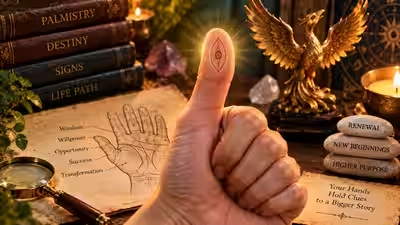

Take a good look at the first joint of your thumb. Are there separate lines creating an oval, almond or eye shape?In palmistry, this unusual mark is commonly called the Phoenix Eye. Some schools of Indian palmistry attribute a similar formation to the Yava or barley-shaped sign. It is considered rare, and traditional readers associate it with intelligence, good judgement, a capacity to learn, prosperity, and the ability to bounce back after setbacks.But the form has to be pretty clear. A Phoenix Eye isn’t just any set of lines crossing randomly.
What is the Phoenix Eye in Palmistry?
The Phoenix Eye is commonly located on the first phalange of the thumb, close to the joint. Two curved lines can intersect in such a way that a closed or almost closed eye-like shape is created.In traditional palmistry, the thumb is very important as it represents willpower, reasoning, decision-making, and self-control.So when a clear eye-shaped mark shows up here it is read as more than a decorative line.The symbolism is about consciousness.Traditionally, a person with this mark is thought to spot patterns quickly, understand people well, and learn from experience rather than repeat the same mistakes.
Is the Phoenix Eye an Indicator of Intelligence?
One of the most common interpretations connects the Phoenix Eye to sharp observation and practical intelligence.That doesn’t necessarily mean intellectual brilliance.Instead, the person may be good at reading situations, understanding motives, spotting opportunities or finding a solution before anyone else even knows there is a problem.In the professional world, this may be strategic thinking, business acumen, research skills or good judgement.The clearer and more complete the formation, the more powerful the symbolism may be, according by traditional palmists.
The Phoenix Eye is a sign of wealth?
Online, the Phoenix Eye is sometimes said to be a sure sign of wealth. That is too simple an understanding.The marking in traditional palmistry may suggest wealth, but it is generally associated with a person’s ability to use intelligence and judgement well.Thus, the symbolism is less about money appearing magically and more about making choices that can lead to better financial results.Other parts of the palm would also have to be studied before any monetary interpretation could be made.A Phoenix Eye alone cannot tell whether someone will be rich.
Why call it the Phoenix Eye?
The phoenix is a legendary bird that symbolises renewal and rising from the ashes.That symbolism adds another layer of meaning to palmistry.People with this marking are sometimes said to have a strong ability to recover. They may experience setbacks but are believed to learn from them and rebuild rather than remain defeated.This applies to career, finances, relationships, or self-confidence.The person may not always escape difficulty. Afterwards, they say, is where they get their strength.
What if the Phoenix Eye is Damaged?
Incomplete formation is traditionally considered less important than clear enclosed formation.If the shape is broken, heavily crossed, or hard to discern, palmists will read the sign with more reservation.A broken formation may symbolise potential that is inconsistent due to poor judgement, distraction or lack of discipline.Again, the hand is scored as a whole.Traditionally, palmistry does not read any one mark in isolation. The head line, fate line, thumb shape, mounts, and other markings can all alter the interpretation.
Is the Phoenix Eye Scientifically Validated?
No. Palmistry is a traditional system of divination and symbolic interpretation, not a scientifically validated method of predicting intelligence, wealth or future events.However, the Phoenix Eye is one of the more interesting marks in palmistry, as it combines three very powerful concepts: awareness, judgement and the ability to rise again.If you find an eye-shaped formation on your thumb, the most interesting question may not be whether it guarantees luck, but whether you recognise those qualities in the way you actually handle life.