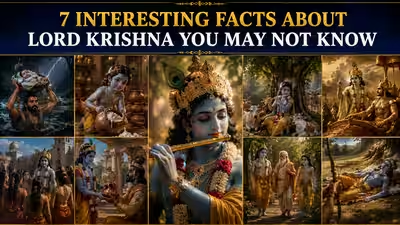
The Krishna most people carry in their heads is a composite of about four scenes: a baby smuggled across a flooding river, a boy stealing butter, a flute under a kadamba tree, a charioteer reciting the Gita. Those images are not wrong; they are just thin.The Mahabharata, the Bhagavata Purana, the Harivamsha, and the Vishnu Purana, between them, give us a much stranger, more contradictory figure: a diplomat who loses arguments, a man publicly accused of theft, a warrior who breaks his own oath, a friend who dies by accident after decades of knowing exactly how he would die.The four texts do not always agree on names, numbers, or sequence, and that disagreement is itself part of the story—a sign of how many hands retold Krishna before anyone wrote him down. Here are seven episodes that rarely make it into the calendar art.
The number 16,108 is not the harem it sounds like
The Bhagavata Purana and later tradition describe Krishna as having 16,108 wives, and the figure gets repeated as a punchline about excess. The story behind it is grimmer.Narakasura, a king ruling near Pragjyotisha, had abducted thousands of women and held them captive, a count that shifts between 16,000 and 16,100 depending on whether you read the Bhagavata Purana and Mahabharata or the Vishnu Purana and Harivamsha.Krishna, with his wife Satyabhama fighting beside him, killed Narakasura and freed the women. Freed did not mean safe. Society then treated women who had lived under another man’s roof, willingly or not, as unmarriageable and disgraced.Krishna married all of them himself, giving each his name and his household’s protection so the stigma could not follow them. It is a rescue story wearing the disguise of a romance.
He swore off weapons, and Bhishma nearly made him break it
As Arjuna’s charioteer at Kurukshetra, Krishna took a vow not to lift arms in the war at all, offering counsel instead of combat.Bhishma, fighting for the Kauravas with a fury tearing through the Pandava ranks, is said to have deliberately provoked Krishna, needling him about the vow, almost daring him to break it.On one of the war’s bloodiest days, with Arjuna faltering, Krishna leapt off the chariot, seized a broken wheel, and charged at Bhishma. Arjuna had to physically hold him back.The moment matters because it shows Krishna’s neutrality was a policy held under visible strain, not a law of nature.
He was accused of murder and theft, and had to solve the case himself
The Syamantaka jewel, a gem that generated gold and warded off calamity, belonged to a Yadava named Satrajit, who feared Krishna would ask him to hand it over. He gave it instead to his brother Prasena.Prasena was killed by a lion while wearing the jewel. When he turned up dead and the jewel vanished, Dvaraka’s gossip settled on Krishna as the killer.Furious, Krishna tracked the lion’s trail to a cave where the bear king Jambavan was keeping the jewel for his children to play with. He fought Jambavan, recovered the gem, and returned it publicly—a rare moment of a god having to produce evidence.
His signature weapon was not his to start with
Popular art puts the discus permanently in Krishna’s hand, as though it were part of his body. The Mahabharata’s account of the Khandava forest fire tells a different story.Agni, trying to consume the forest and regain his strength, asked Krishna and Arjuna to hold off Indra’s rain. Varuna armed them for the task, giving Arjuna the Gandiva bow and Krishna the Sudarshana chakra, along with the mace Kaumodaki.The chakra, in other words, is a battlefield gift, acquired for a job, not an original attribute.
He raised the dead as a tuition fee
Sent to study under the sage Sandipani at Avanti, Krishna and Balarama finished their training and asked what guru dakshina, the fee owed to a teacher, he wanted.Sandipani asked for his son back, lost years earlier at Prabhasa. The brothers traced the boy to a demon named Panchajana, killed him, and claimed his conch shell, but still found no son.Krishna eventually went to Yamaloka, the abode of the dead, and negotiated with Yama himself to bring the boy home.
His brother sat out the entire war and went sightseeing along a dying river
Balarama refused to fight at Kurukshetra on either side, unwilling to face Krishna’s allies or his own student, Duryodhana. He left for a pilgrimage tracing the Sarasvati river’s sacred fords instead, an episode to which the epic devotes a whole section.He returned only after the war ended.
He died from a hunter’s mistake, thirty-six years after a curse he had already accepted
Gandhari, grieving her hundred sons, cursed the Yadava clan to destroy itself. Decades later, during a drunken brawl at Prabhasa, the Yadavas killed each other with iron clubs grown from a cursed weed.Krishna withdrew to the forest afterward and sat in meditation. A hunter named Jara, mistaking the mark on his foot for a deer’s eye, shot an arrow that killed him almost incidentally.What lingers, reading these four texts against each other, is not the miracles but the arguments they keep having with themselves: over a number, a jewel, a wheel picked up in anger.A tradition confident enough to preserve its own contradictions is not hiding anything. It is just older than any single version of the story it tells.