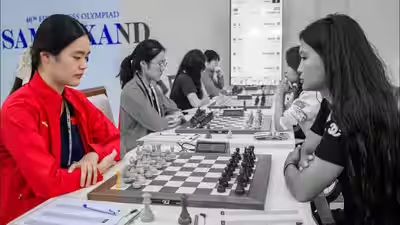
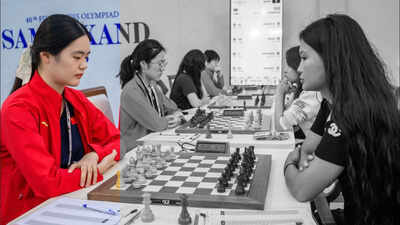
NEW DELHI: The 46th edition of the Chess Olympiad is currently edging towards its climax in Samarkand, Uzbekistan. In the women’s section, one team has pulled clear of the rest, and it is China, the comfortable leaders at the moment. And if anything doesn’t go south, it will be the Chinese girls donning the gold medals around their necks at the end of 11 rounds of play. But do you know the most interesting thing in it? China don’t even have their strongest players in the event.As per the current FIDE ratings, none of the world top three, which include Hou Yifan, the current women’s world champion Ju Wenjun, and Lei Tingjie, is part of this Chinese side. Zhu Jiner, the world no. 4, is thus on Board 1, facing the toughest of the top board opponents at this Samarkand Olympiad. And she has risen to the challenge, remaining unbeaten throughout, a complete turnaround from her form at the Global Chess League (GCL) in India just a couple of weeks earlier.Just before the Olympiad, Jiner was part of the two-time GCL champion Triveni Continental Kings, who had a torrid event as they finished second from bottom in the group stage this time. Jiner’s performance was not up to the mark either, with the 23-year-old Grandmaster winning just one, losing four and drawing five games in the tournament.The on-board results, coupled with the hectic schedule, meant little time or urge for her to enjoy the city of Bengaluru, the host of this fourth edition of GCL.
Finding warmth amid a difficult campaign
Despite her struggles on the board, Jiner maintained a deep appreciation for the host nation. “This is my first time in Bengaluru, and overall, I’ve had a very good impression of the city. The weather is also very pleasant,” Jiner told TimesofIndia.com during an exclusive interaction.“Since I’m here mainly to compete in the Global Chess League, there’s been quite a lot of time spent on matches and preparation, so I haven’t really had much time to go out. When I have a game, most of my energy is focused on the competition.”Bengaluru was simply the latest stop in Jiner’s long-standing relationship with Indian chess venues, having previously played across the country’s major hubs.“I’ve been to India several times before. I’ve visited New Delhi, Pune, Mumbai, and now Bengaluru, all for international chess tournaments,” she recounted. “What I like most about India is how passionate people are about chess. Whether they’re players or fans, you can really feel their love for the game. For example, during this Global Chess League, the players have received such a warm welcome from the local fans. Every day, when we come out of the playing venue, there are so many chess fans waiting to get autographs or take photos with their idols. That atmosphere has left a very deep impression on me.”Jiner also noted the broader cultural and competitive ties between the two Asian superpowers, acknowledging the explosive growth of Indian chess talent on the global stage.“I think India has a very long and rich history and culture. I’ve heard some Indian mythological stories as well,” she observed. “At the same time, India is a very vibrant and rapidly developing country, and there is a lot of trade and exchange between the two countries (India and China). As far as modern chess is concerned, India has developed incredibly quickly over the past few years, especially when it comes to the younger generation. There are now many very talented young Indian players, and they have achieved excellent results in international competitions again and again.”
From four-year-old beginner to China’s Board 1
Jiner’s journey to leading China’s national team on Board 1 in Samarkand was built on decades of steady progression. “I was introduced to chess when I was about four years old. At first, it was very simple, I just thought the game was interesting and enjoyed playing it,” Jiner recalled.“Then, when I was around seven, I joined the Zhejiang team and began receiving more systematic training. Later, I joined the national team and gradually started competing at higher and higher levels. Actually, there wasn’t one particular moment when I suddenly decided, ‘I want to become a professional chess player.’ It happened gradually. Over time, chess became a very important part of my life, and eventually becoming a professional player felt like a natural choice for me.“
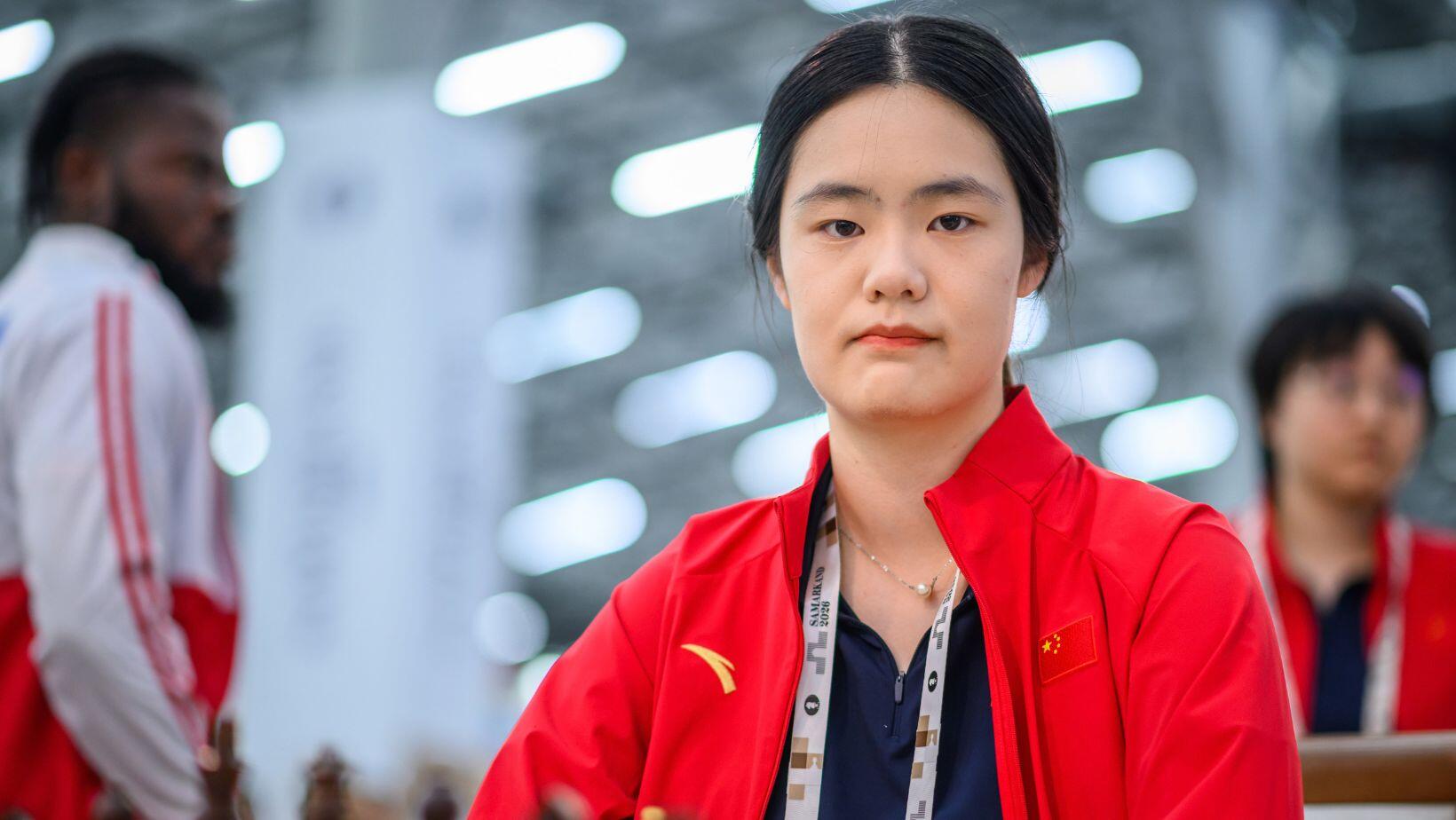
Her personal trajectory mirrors the unique structure of Chinese chess. “Chess came to China relatively late. It has been around for many years now, but compared with some other sports, it is still a relatively niche sport,” Jiner explained.“I’m not very familiar with the current development system for young Chinese players, but I think for a little girl who is just starting to learn chess, the most important thing is to first develop a genuine love for the game. The professional path is actually very long, and there will be many difficulties along the way. If you really love the sport, that’s what will help you keep going.”
Steering the ship in Samarkand
That resilience proved essential as China arrived in Samarkand without its standard contingent of World Champions. Leading an understrength team, Jiner reframed the narrative, turning the absence of superstars into a source of resolve.“I think China has some of the strongest female players in the world, and overall, the team has consistently been among the strongest,” Jiner noted before the start of the tournament. “However, this time, the Chinese team hasn’t been able to compete at the Olympiad with its most complete and strongest lineup, which I personally feel is a little unfortunate.”Rather than letting the pressure of top-board responsibility overwhelm her squad after the setback in India, Jiner embraced the lowered expectations, which has worked well for her and her team so far.ALSO READ: Juggling Chess Olympiad prep and a commentary gig in India: The other side of USA’s only female GM Irina Krush“Of course, even under these circumstances, the Chinese women’s team is still a very strong team. But there are many strong teams at this Olympiad, and I think the competition between them will be extremely intense. So I wouldn’t consider China the biggest favourite to win the title. For us, that actually means there isn’t too much pressure. We’ll prepare carefully for each round, focus on the opponent in front of us, try to play at our best, and aim for a good result.“Jiner may not have considered China the biggest favourite to win the title. But that pragmatic, round-by-round focus is now on the verge of delivering one of the most remarkable gold medal runs in modern Olympiad history.