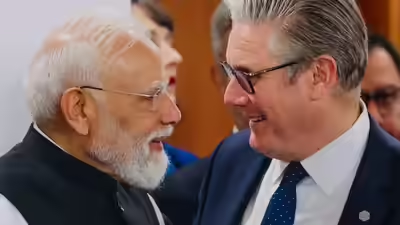
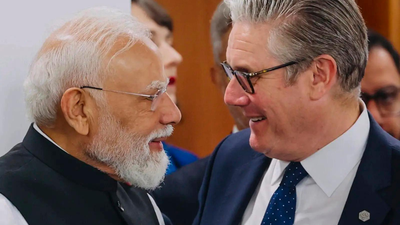
NEW DELHI: The India-UK free trade agreement (FTA) and the social security deal are set to be operationalised from July 15 after talks between PM Narendra Modi and his counterpart Keir Starmer in Evian on Wednesday.“We have got an even solution that balances the interests of our stakeholders on the issue of steel,” a senior govt official told TOI.
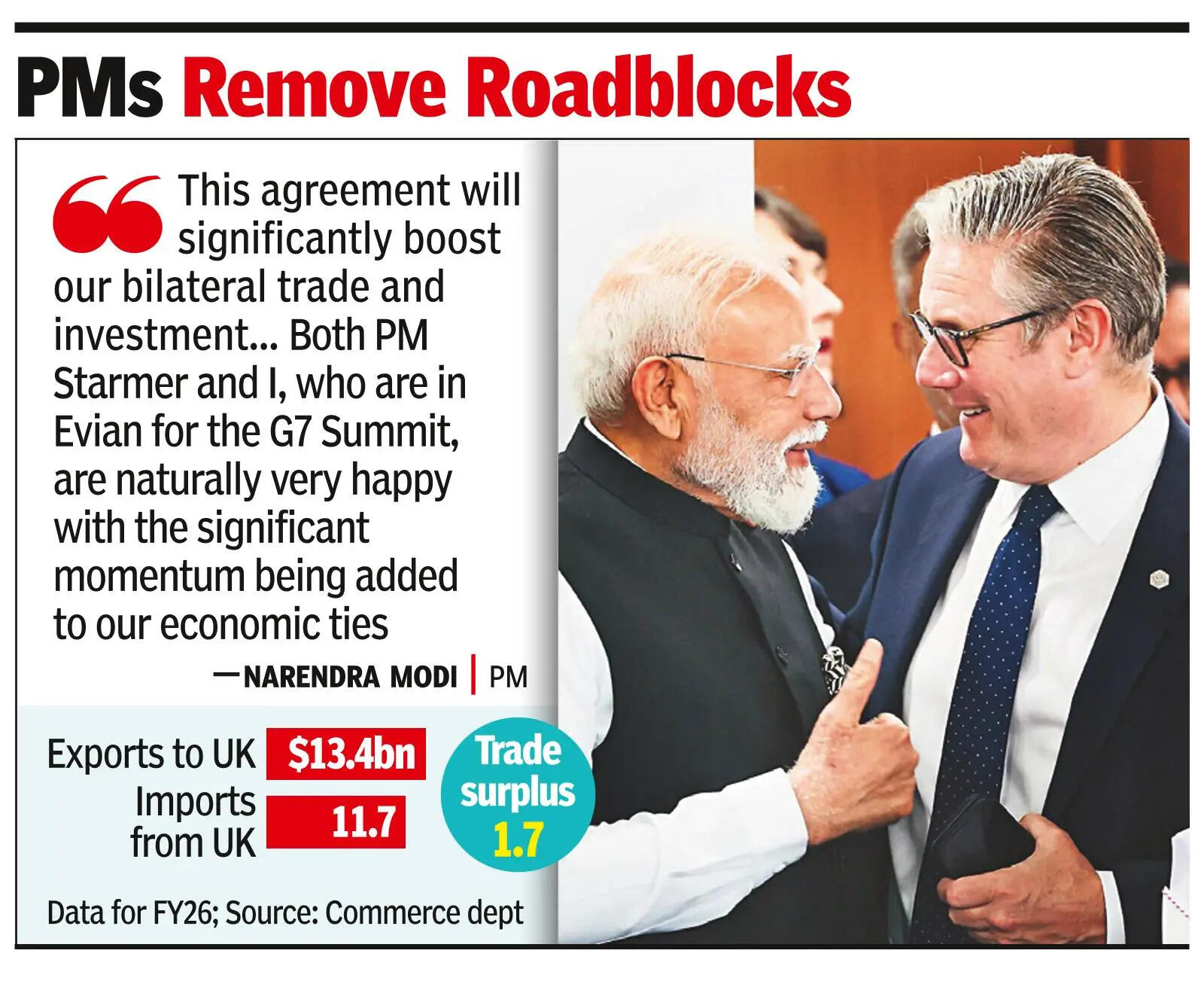
While India and the UK were looking to implement the Comprehensive Economic and Trade Agreement, which will eliminate tariffs on 99% of exports from the country and also open services sectors along with easier visa rules, the Starmer govt’s decision to impose tariffs on steel product irked New Delhi, which decided to hold back rollout of FTA. Govt also wanted an assurance on the carbon border adjustment mechanism but it is unclear if any concession was given since there was no agreement on the issue at the time of finalising the trade deal.“Following constructive deliberations regarding the UK’s upcoming steel measures effective July 1, 2026, both sides mutually agreed to protect commercial interests, minimise market disruptions and ensure an overall balanced and stable trading environment for exporters. 85% of India’s exports are out of the steel measures. On the lines under the steel measures India’s interest has been protected through a mix of CSQ (country specific quotas), residual quota and access under Authorised Use Scheme,” the commerce department said in a statement.Implementation of the treaty, which was finalised in May 2025, comes at a time when attention is set to return to US tariffs, with the deadline for the end of the 10% additional levy is barely five weeks away and a new tariff structure is to be announced by Trump administration.“By securing immediate duty-free access on 99% of our tariff lines, we have systematically dismantled long-standing tariff walls. This will effectively level the playing field, allowing our textiles, leather, marine, engineering and processed food sectors to compete with no disadvantage and supply their world class products. Crucially, this structure is built on absolute economic security; stringent exclusion lists are actively deployed to insulate our sensitive agricultural and rural economies from import volatility. Simultaneously, by exempting our professionals from double insurance contributions, we are protecting the financial interests of our talent pool,” commerce & industry minister Piyush Goyal said in a statement.For Indian consumers, the deal will allow the entry of Scotch at lower duties (a drop from 150% to 40%) along with automobiles (100% to 10% with quotas) and cosmetics (22% to zero).